🚀 Fast processing & tracked delivery
⭐ Loved by thousands of creators
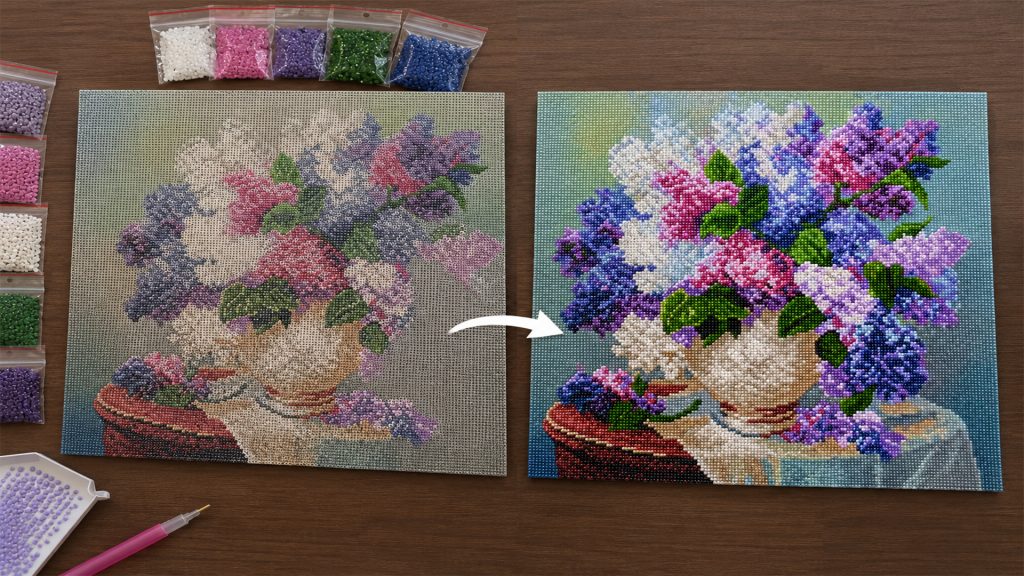
A finished diamond painting has a way of making the process look effortless. Once it’s framed or resting on a table, all you notice is the sparkle, the colors, and the level of detail created by thousands of tiny diamonds. It’s easy to admire the result without giving much thought to where it started. Place that same finished painting beside the untouched canvas, however, and the contrast is almost surprising. The completed artwork feels rich and alive, while the original canvas looks flat and covered in symbols. At first glance, it barely resembles the image it will eventually become. Seeing the two versions side by side is a reminder that every finished diamond painting begins in exactly the same place. It all starts with a design that’s simply waiting to reveal itself.
The first time you look closely at an untouched canvas, your eyes are drawn to the symbols rather than the artwork. Letters, numbers, and small icons cover the entire surface, breaking the design into hundreds of tiny sections that don’t immediately make sense. Depending on the image, you may be able to recognize a few larger shapes, but the finer details often disappear beneath the printed guide. A portrait can look incomplete, flowers become scattered patches of symbols, and a landscape loses much of its depth. If someone had never seen the finished version, they might struggle to guess what the artwork is supposed to become.
One of the intriguing aspects of diamond painting is that. The image is already there from the beginning, yet it feels buried. Nothing needs to be sketched or painted, but everything still has to be disclosed. The symbols aren’t replacing the artwork, they’re temporarily standing in front of it, ready to disappear one diamond at a time.

The first completed section rarely transforms the entire canvas, yet it changes the way you look at the project. A small corner that was once covered in symbols suddenly has color, texture, and a completely different appearance from everything surrounding it. The contrast between the finished area and the untouched canvas becomes impossible to ignore. For the first time, the printed guide starts giving way to the actual artwork, and what looked confusing only moments earlier begins to make sense.
That difference is more important than its size would suggest. Completing a single section doesn’t simply add a few rows of diamonds; it changes your perspective. Instead of wondering how a canvas full of symbols could ever become the picture on the cover, you begin to understand the process. Every completed section becomes a preview of what the rest of the canvas will eventually look like, making it easier to imagine the finished artwork even though most of the symbols are still visible.

Photographs taken at the start of a project and again midway through often show much more change than you might recall. Because you’re observing the changes in real time while working on a diamond painting, progress often feels slow. Looking back at an older shot gives a different narrative. Outlines have become more distinct, areas that previously appeared vacant are now filled with color, and features that previously seemed unrecognizable now feel apparent.
This is usually the stage where the artwork stops looking like separate sections and begins feeling like a single image. Colors no longer appear as isolated patches. They blend naturally into one another, creating shadows, highlights, and depth that weren’t there before. A pet‘s face gains expression, the branches of a tree stand apart from the sky behind them, and the reflection on a lake begins to look almost lifelike. The canvas doesn’t transform because of one dramatic moment. It changes because hundreds, or even thousands, of small decisions quietly build on one another.
Looking at the painting now, it’s difficult to remember how uncertain the beginning felt. The symbols that once dominated the canvas have already started fading into the background, replaced by an image that’s becoming easier to appreciate with every completed section.

By the time only a few empty spaces remain, the painting already looks complete from a distance. Most of the symbols have disappeared, and the colors now flow naturally across the canvas. The full design stands out instead of individual sections. The remaining work is no longer about discovering the picture. It’s about refining it. Those final diamonds sharpen small details, adding texture and brightness that quietly bring the composition together.
Once you place the final diamond, the difference between the first day and the last is impossible to ignore. Thousands of carefully placed diamonds now reflect the light, giving the canvas a depth that a printed design alone could never achieve. The sparkle naturally catches your eye, but it isn’t the only thing that has changed. The entire piece has taken on a different character. It no longer serves as a guide for placing diamonds. Instead, it stands as a finished artwork in its own right.
The most satisfying comparison isn’t between two photographs taken a few days apart. It’s between the untouched canvas and the finished painting lying beside it. One still carries every printed symbol, every empty space, and every possibility that comes with a new project. The other shows what patience and consistency can create when those symbols slowly disappear beneath thousands of carefully placed diamonds.
Viewed together, they tell a story that neither version could tell on its own. The unfinished canvas reminds you where the project began, while the completed painting shows where all those small sessions eventually led. It’s easy to admire the sparkle of a finished diamond painting, but the real beauty of the before-and-after comparison is seeing just how much the artwork changed without ever changing its design. The picture was always there. The diamonds simply brought it into view.

Perhaps that’s why so many people enjoy taking photographs throughout a project. The finished artwork is something to display, but the earlier photographs preserve something different: the transformation itself. Looking back at the first image after the painting is complete makes it easier to appreciate details that would otherwise be forgotten, from the sea of printed symbols that once covered the canvas to the first small section that hinted at what the artwork would become.
In the end, the appeal of a diamond painting’s before and after isn’t simply that one version looks better than the other. It’s that the comparison captures the entire journey in a single glance. Every completed section, every color placed, and every symbol covered contributed to a change that happened so gradually it was almost invisible while it was taking place. Only when the beginning and the end are placed side by side do you fully realize just how remarkable that transformation really is.
Discover Our Most Loved Kits
Extra Fine Pen For 5D Diamond Paintings
29.85 $Original price was: 29.85 $.22.85 $Current price is: 22.85 $.Diamond Painting Kit Paw Patrol | Premium DIY Artwork
Kentucky Wildcats Basketball Team – Diamond Paintings
Arkansas Logo – Diamond Paintings