How to Start Diamond Painting
Everything a first-timer needs — what’s in a kit, how to set up, the technique, and how to pick a starter design you’ll actually finish.
What is diamond painting?
Diamond painting is a relaxing craft where you place tiny, faceted resin “drills” onto a pre-printed, colour-coded canvas. Each symbol on the canvas matches a numbered drill; as you fill it in, a sparkling, mosaic-style image appears. It’s often compared to paint-by-numbers and cross-stitch — but the finished piece shimmers like a gem. The “5D” simply means the drills have extra facets for more sparkle.
What you need to start
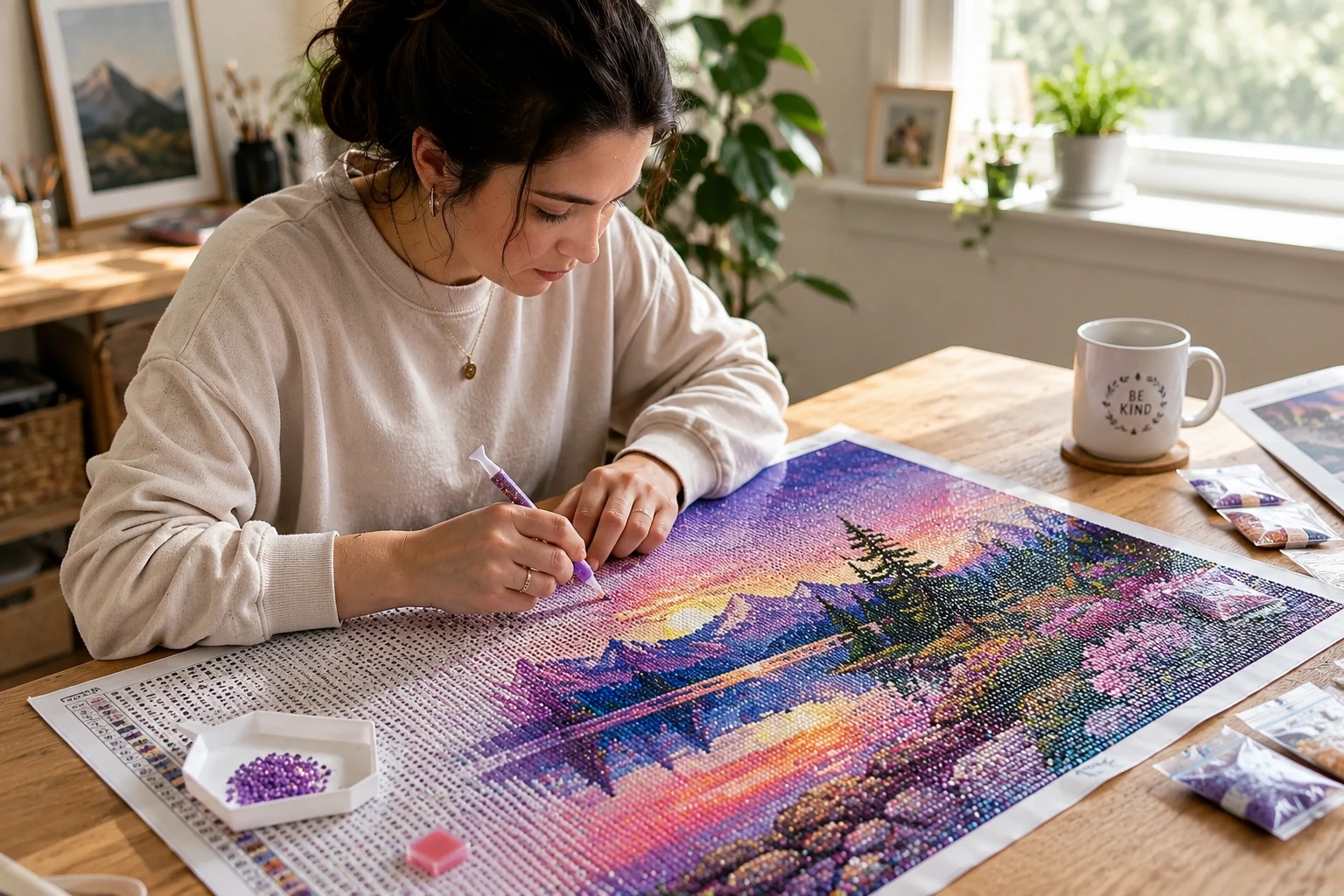
The good news: a complete 5D Diamond Painting kit includes everything. You don’t need to buy anything separately.
- The canvas — pre-glued, printed and colour-coded.
- The drills — numbered, DMC-matched, with spares.
- The pen, wax and tray — the full tool set.
A well-lit table, an hour to unwind, and you’re ready.
Step-by-step for your first session
- Lay the canvas flat on a clean, hard surface. Smooth out any curl.
- Pour one colour of drills into the tray and shake gently so they sit face-up.
- Peel back a small corner of the protective film — just enough for the area you’re working.
- Wax the pen, touch a drill, and lift it out of the tray.
- Press the drill onto its matching symbol. Repeat, working one colour and one small area at a time.
- Press it flat at the end and reseal any film you’re not using.
For a fuller walkthrough with round-vs-square advice, see How Diamond Painting Works.
Choosing your first kit
Set yourself up to succeed:
- Start smaller. A 20×20 to 30×30 cm canvas gives a quick, satisfying win before you commit to a big piece.
- Pick round drills for your first kit — they’re the most forgiving.
- Choose a design with fewer colours to keep sorting simple.
- Browse our beginner-friendly collection, made exactly for this.
Unsure on size? Our size guide maps sizes to time and difficulty.
Beginner mistakes to avoid
- Peeling all the film at once — the glue dries out and drills stop sticking. Peel a little at a time.
- Overloading the pen with wax — a small amount is plenty; too much leaves residue.
- Starting too big — a giant, highly-detailed canvas can overwhelm a first-timer. Build up to it.
- Skipping the final press — flattening the canvas at the end keeps drills from lifting over time.
Ran short on a colour? It happens even with surplus. We send free replacement drills for life — just contact us with your kit and the colour number.
Finishing and framing
When the last drill is placed, press the whole canvas flat, and optionally seal it with a brush-on sealer for extra hold and shine. Then frame it like any piece of art. Full-drill coverage and true DMC colour mean it’ll read sharp on the wall — that’s the whole point.
How much does it cost to start?
One of the nicest things about diamond painting is how affordable it is to begin. Because every kit is complete — canvas, drills and all the tools included — a single kit is genuinely all you need for your first project. There’s no expensive starter set, no subscription, and no long list of extras to buy before you can begin. As you get into the hobby you might add a few nice-to-haves like a daylight lamp or a grid storage box, but those are optional comforts, not requirements. Compared with most creative hobbies, the cost of entry is low and the hours of enjoyment per kit are high.
Is diamond painting worth it?
If you’re looking for a calm, screen-free way to unwind that leaves you with something real to show for your time, it’s hard to beat. The gentle, repetitive rhythm of placing drills is genuinely relaxing — many makers describe it as meditative — and unlike scrolling or watching TV, you end each session having made visible progress on a piece of art. Finish it, frame it, and you’ve got a personal decoration or a heartfelt gift. Add in how beginner-friendly it is and how little it costs to start, and it’s easy to see why so many people finish one kit and immediately reach for the next.
Keep going
Once you’re hooked (you will be), explore the full kit collection, try a custom kit from your own photo, or read the rest of our beginner articles. Happy painting!